

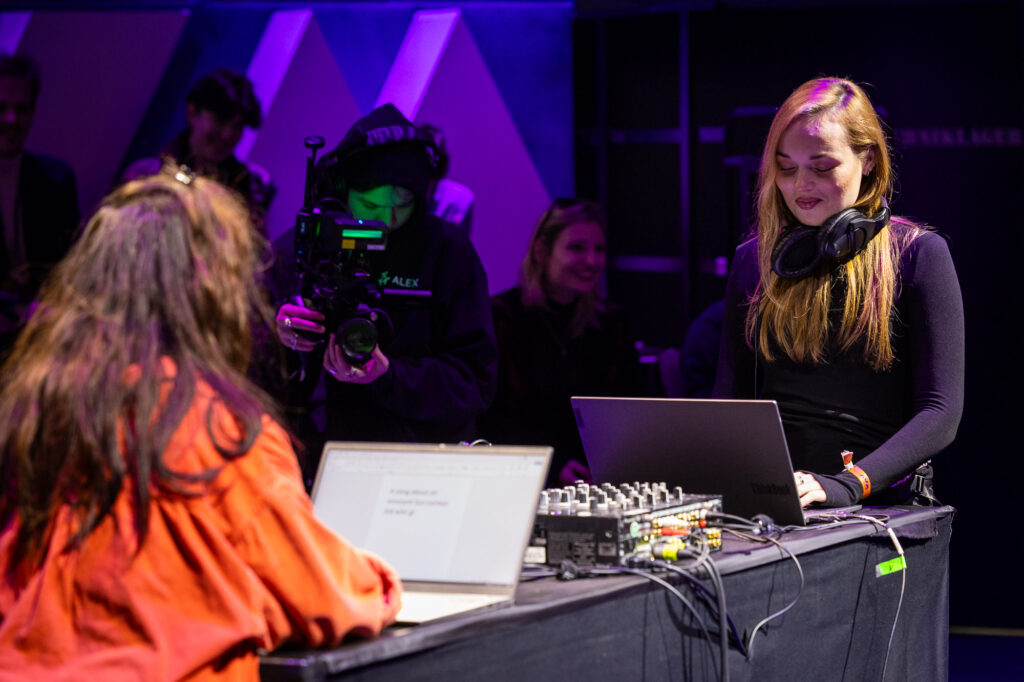
Hybrid Music Lab began in 2016 as a platform for exploring new forms of musical expression, emerging genres, and immersive production methods within the context of Most Wanted: Music. Since then, it has become a space for performances, conversations, and experiences that sit at the intersection of experimentation and forward-thinking technologies.
Today, Hybrid Music Lab continues to evolve as a dynamic and hands-on enrichment of the main MW:M conference – an open space for curious minds to explore how music, tech, and innovation come together.
The Lab features both a range of interactive performances and an exhibition space that invites participants to play, question, and co-create. Expect interactive art performances, AI-driven instruments and novel interfaces for musical expression – alongside talks and demos that unpack the ideas behind the creations.
Whether you’re a musician, fan, producer, technologist, researcher, or simply curious, Hybrid Music Lab offers a place to connect, reflect, and experiment. You’ll leave with fresh perspectives, new connections, and ideas that just might keep you up at night – in the best possible way.
HML Sessions
Format
Language
Location
Topic Stream
Vertical
Format
Language
Location
Topic Stream
Vertical
Conference Track
MOO-SiC: A Live Coded Musical Performance
The text based VR, called a MOO, was invented in the 1990s; it consumes few resources and can be made to work with screen readers. As a low-resource project, it is a degrowth tele presence, accessible to users of older hardware, people with slow connections and self- hosters.
The use of text description creates a more detailed and robust improvisatory environment than the limited visual language of graphical VR and the metaverse. Text descriptions create images in the viewer’s minds, (rather than as a prompt to a generative AI) and engage imagination and creativity. The music will be a live-generated sound track to the virtual space.
-
Shelly Knotts
Relativity: A Hybrid Performance System for Processing Environmental Signals Through Analog and Spatial Technologies
The work originates from a glacial expedition with the Icelandic Glaciological Society on Vatnajökull, Iceland, where hydrophones, geophones, contact microphones and environmental recording techniques were used to capture acoustic traces of glacial activity, which were then transformed through a live processing system.
Inspired by scientific sensing methods including Radio Echo Sounding (RES), seismic monitoring, and glaciological measurement techniques, Relativity explores the relationship between environmental sensing and musical production.
The performance outcome is a 4-channel spatial composition that uses multichannel diffusion to create an immersive listening environment.
-
Morgan Hickinbotham
Void: Rewiring Audience Smartphones into a Distributed Musical Instrument
The work addresses a contemporary paradox: technologies designed to connect people increasingly shape individual perceptual spaces. Void reconfigures this condition by combining a common acoustic environment with distributed audiovisual events generated on personal devices. Each participant contributes to the performance while experiencing a unique perspective, creating a constantly shifting dialogue between public and private space, presence and isolation, individual experience and collective listening.
Void proposes an artistic reflection on how everyday digital devices shape the contemporary social experience and how they can be temporarily reimagined as part of a shared performative environment.
-
Lorenzo Ballerini
Folded Bodies: Performing with Artificial Nervous Systems
In this new version, created for MW:M, two instances are networked into a quartet — two performers, two nervous systems. Each body is rendered on its own projector — two organisms, two screens, two voices — and spikes from each network cross the wire to stimulate the other. Each machine becomes the other’s environment. The performers fold, tune, and perturb, but never fully control: the performance is a four-way negotiation of attention, in which humans relate to their own instruments, to each other’s, and to each other through machines that are also negotiating with each other.
-
Lucas Kuzma -
Sébastien Roger
Opto-Sonic:Cube: A New Optical Electronic Musical Instrument
Rather than eliminating signal interference and interruption, Opto-Sonic:Cube embraces them as expressive musical elements, reinterpreting visible light communication as a performative musical interface. Because light functions simultaneously as both the interaction medium and the sound source, the spatial arrangement and overlap of light directly shape the resulting sound. This will create a performance experience in which visual and auditory perception will be tightly integrated.
-
suzueri
Feel the Mix: Haptic Interfaces for Blind and Partially Sighted Music Producers
-
Joy Bausch -
James Hurley
Faulty Oracle: An Adaptive Audiovisual Installation
By shifting interaction from language to the body, ‘Faulty Oracle’ gleefully dismantles any expectation of precision in human-machine exchange. ‘Faulty Oracle’ is built around real-time AI image generation and responsive sound. A motion-tracking system reads the visitor’s physical presence within the space and uses it to steer both the evolving video and the musical behaviour of the work. On screen, AI-generated imagery is continuously produced, as though the oracle were searching for a language.
The sound is equally reactive: voices and musical textures are shaped by the visitor’s physical inquiry. The piece can be presented in stereo or expanded into optional multichannel diffusion, allowing the oracle’s answers to inhabit the room more fully and spill into the space around passers-by.
-
Alessandro Anatrini
Quantum Computer Music: Talk and Performance
-
Itabora Puy
Protecting the future of music education: An Intuitive Platform for Learning Music
Many believe that AI is an incredible technology that can augment and transform music education when used correctly. This session will demonstrate how AI can be used to teach music interactively, through machine learning software models that analyse songs and the music theory behind them.
The session will show how AI can act as a personal coach that explains concepts, answers questions, and adapts to each learner’s language and needs.
The aim is to make the machine learning software and its core technology available to everyone: giving teachers tools to make learning more effective, while helping individuals overcome barriers and continue learning.
-
Mohammad Tomaraei
Hybrid Music Lab: Exhibition and Performances
Dive in, experiment and experience music, sound and technology coming together in an inspiring, playful environment of discovery and collaboration.
-
Lorenzo Ballerini -
Joy Bausch -
Morgan Hickinbotham -
James Hurley -
Itabora Puy -
Shelly Knotts -
Lucas Kuzma -
Luciana Luthi -
Ployz -
Sébastien Roger